Have you ever stood in front of an audience and wondered how to begin?
You may have prepared the content, designed the slides and rehearsed the main points. Yet the first few sentences can still feel difficult. Do you introduce yourself? Show the agenda? Tell a story? Ask a question? Or simply start explaining the subject?
The opening deserves careful thought because it shapes how the audience listens to everything that follows. A strong opening does more than announce the topic. It gives people a reason to pay attention.
Every presentation has a beginning, middle and end
Whether you are leading a meeting, conducting a workshop or presenting an idea, the session has a structure. At its simplest, that structure consists of the start, the content and the end.
The start prepares the audience for the journey. In a training session, it helps participants understand why the subject matters and what they can expect to gain. In a business presentation, it can establish the problem, opportunity or decision that gives the rest of the content a purpose.
When the opening is handled well, it captures attention and makes the audience curious enough to stay with you. When it is weak or unnecessarily long, people may begin disengaging before the main message has even arrived.
There are many ways to begin
You could start with a story that leads naturally into the subject. You could tell a joke—if humour suits the occasion and you know how to deliver it. You might ask a thoughtful question, describe a scenario or show an unexpected visual.
One approach I often use is to begin with a relevant fact, an observation or a familiar pain point. It works especially well when the audience has experienced the situation themselves.
The opening might cause someone to think, “Yes, I have encountered that,” or, “I would like to know why this happens.” That moment of recognition creates a connection between the audience and the subject before you begin teaching or explaining it.
Begin with something relevant to the subject
Because I teach presentation and visual communication, I may begin by observing that many presentations are frustrating to follow. Slides are cluttered, words are too small, numbers compete for attention and the audience cannot identify which part of the slide the speaker is discussing.
In one workshop, I introduced this problem with the statement that more than 80% of presentations today are frustrating. The figure served as a provocative opening to a familiar problem, rather than as a universal research finding. I immediately explained the observation behind it: audiences frequently encounter slides that are too messy and speakers whose explanations are difficult to follow.
The important lesson is not the percentage itself. It is the connection between the opening and the workshop content. The participants were attending a session about creating clearer and more engaging presentations, so the frustration was something the training would help them address.
Move from the problem to its effect
After naming the problem, I discussed what happens as a result. When audiences cannot follow a presentation, they become confused, lose interest or stop listening. During a long conference or training programme, some may even begin to doze off.
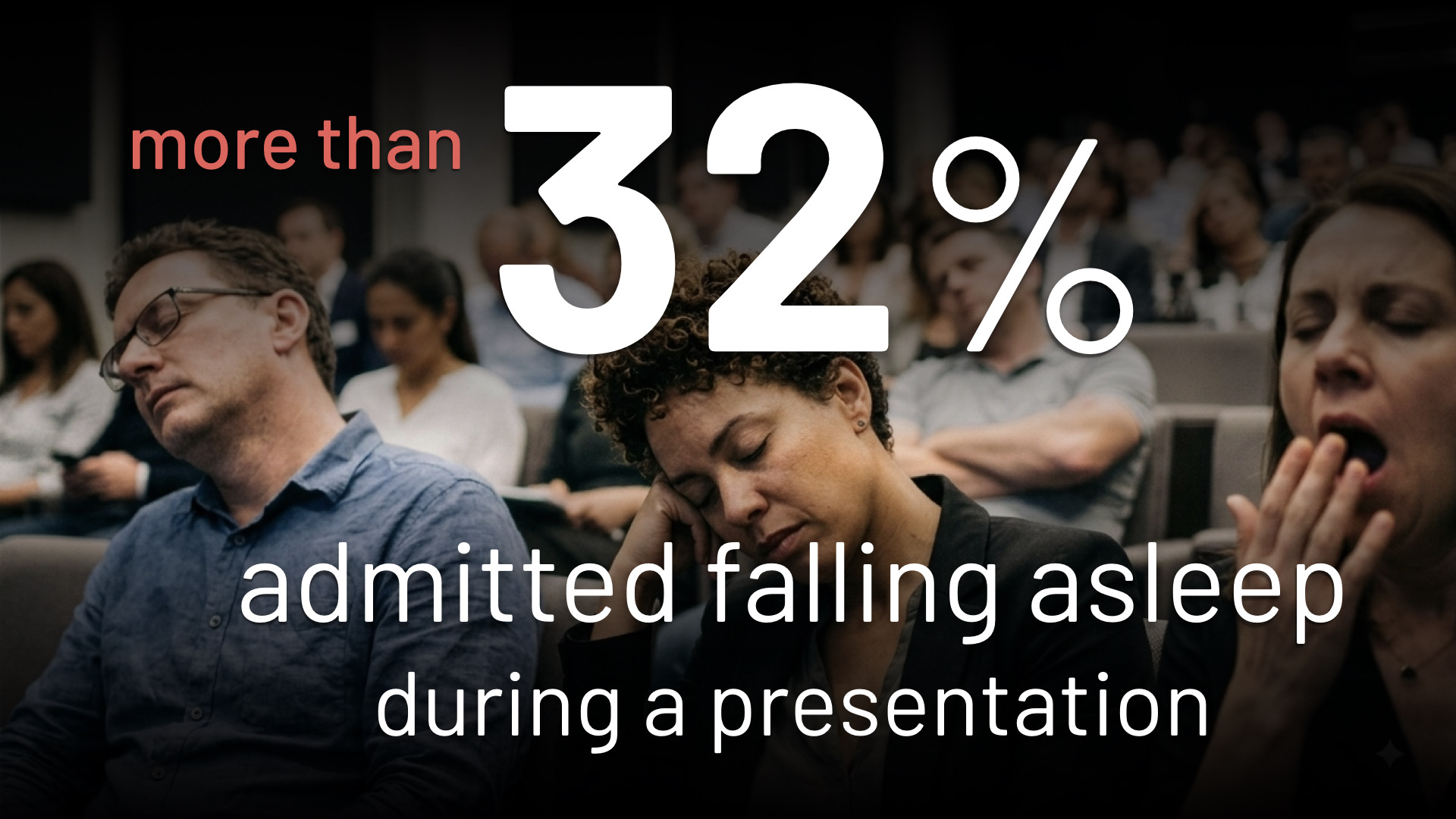
This is not merely an amusing possibility. A 2011 survey commissioned by SlideRocket found that presentations had put more than 32% of its 1,003 respondents to sleep. The survey involved US adults who used office software daily, so the finding should be understood within that context rather than applied to every presentation audience.
This develops the opening beyond an isolated fact. It helps the audience consider the consequence:
- If people cannot find the relevant information on a slide, they cannot follow the explanation.
- If they cannot follow the explanation, they begin to disengage.
- If they disengage, the presentation cannot achieve its purpose.
A useful pain point becomes more meaningful when people can see what it affects. The consequence gives the topic urgency.
Create a question in the audience's mind
Once participants recognise the problem and its effect, questions begin to form naturally. How can I keep an audience attentive through a 90-minute presentation? How do I maintain interest throughout a full-day workshop? How can I explain complicated information without overwhelming people?
You do not always need to ask these questions aloud. If your opening is relevant, the audience may already be asking them internally. This curiosity gives them a reason to listen to what comes next.
The aim is not to use a sensational fact merely to surprise people. It is to open a gap between the situation they recognise and the answer they want to discover.
Show that the session will help
The third part of the opening is to point towards what can be done. In the workshop example, I explained that there are ways to create clearer slides, engage an audience and produce a stronger “wow” during a presentation. I then connected those possibilities to what participants would explore during the training.
This gives the audience a simple reason to remain interested: the session will help them move from the pain point towards a better outcome.
You do not have to reveal the complete solution at the beginning. Give enough direction for the audience to understand that the coming content is relevant and worthwhile.
The three-part opening
The workshop opening can be reduced to three moves:
- Name a relevant fact, observation or pain point. Begin with a situation the audience can recognise and connect it directly to your subject.
- Explain the effect. Show why the situation matters and what happens when it remains unresolved.
- Point towards a better outcome. Let the audience know that the presentation will help them understand or address the issue.
This structure is simple, and it creates a logical movement from recognition to concern and then to possibility.
Adapt the idea to your own subject
The same approach can work beyond presentation training. Imagine that you are teaching people how to grow vegetables using hydroponics. You could begin with a relevant observation about the limitations of conventional growing space, a fact about food production or a pain point faced by people who want fresh vegetables but have little land.
You could then explain the consequence and introduce hydroponics as an approach the session will explore.
A business proposal might begin with a service delay customers repeatedly experience. A safety briefing might open with an observed behaviour that increases risk. A change-management presentation might begin with the frustration employees feel when several systems require the same information.
In every case, the opening belongs to that particular audience and subject. A fascinating fact that has no connection to the presentation will only create confusion.
Choose facts carefully
If you present something as a factual claim, make sure it is accurate, current and supported by a credible source. A weak or exaggerated statistic can distract the audience and damage trust.
You do not always need a dramatic number. A well-framed observation can be just as effective:
- “Many customers repeat the same information each time their enquiry is transferred.”
- “Our monthly reports contain more data, but the decisions have not become easier.”
- “Most of us have attended a presentation where we could not identify the speaker's main point.”
These openings invite recognition without pretending that an unsupported estimate is a proven fact.
Keep the opening short and purposeful
A long workshop may need a more detailed introduction and a clear explanation of its agenda. A short presentation usually needs much less. Once the audience understands the issue and wants to know what follows, move into the content.
Avoid turning the opening into a second presentation. Its job is to create attention, relevance and direction.
Before you begin, ask three questions
When preparing your next presentation, consider:
- What situation does this audience already recognise?
- Why does that situation matter to them?
- How will my presentation help them understand or improve it?
The answers can give you the fact, observation or pain point that opens the presentation naturally.
You may eventually develop a different opening style that suits your personality and audience. Whatever approach you choose, do not begin merely because it is time to start speaking. Begin by giving people a reason to listen.


